
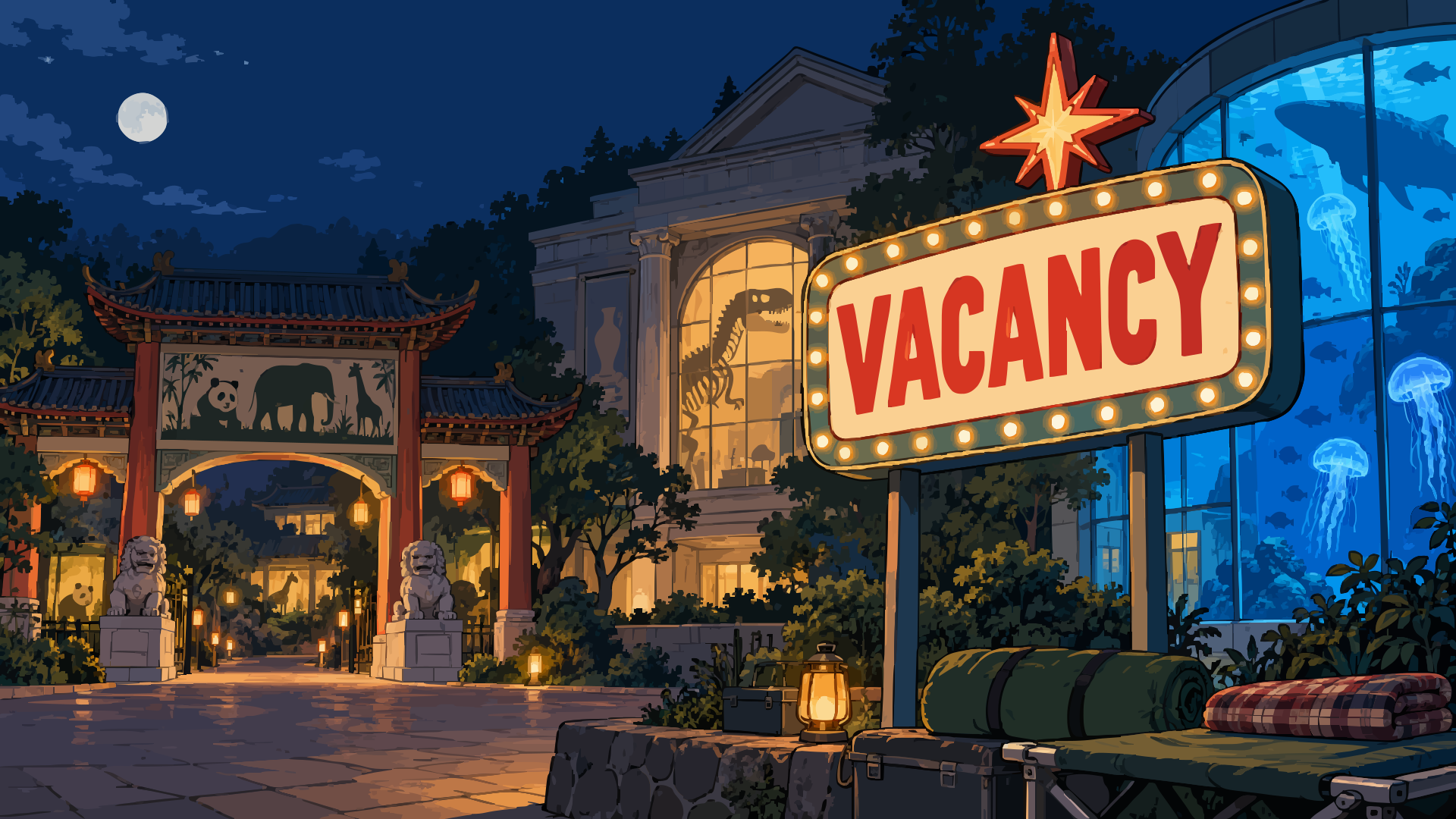
Healing in the Dark: Young adults are paying for sleepovers
25-year-old Song Jingyi never thought she’d wake up in a zoo, with the memory of being startled by a lynx vigorously tapping on a glass window remain vividly in her mind. It was now 8 a.m. at Nanjing Hongshan Forest Zoo, and everyone seemed slightly fatigued. Yet the excitement from last night’s adventure hadn’t faded.
Unlike daytime demeanor that can be permeated with a distinct “office stench,” participants saw the behind-the-scenes lives of animals as brimming with delightful surprises. Some timid creatures chose to engage in activities at night, and, of course, you could also catch a porcupine family enjoying their late-night snack or a giraffe staying up late.
The ‘duet’ of wolf howls and the chorus from the monkey hill is a truly unique lullaby.
“The ‘duet’ of wolf howls and the chorus from the monkey hill is a truly unique lullaby,” said Song Jingyi, who is about to complete her doctoral degree.
In the post-pandemic era, a growing number of tourist attractions in China, particularly zoos, museums, and aquariums, have begun offering sleepover projects. Originally designed as family-focused study tours, it is born out of the concept “learning beyond the classroom” and has become a splash of color in the development of China’s tourism market. The niche features of travel-off-peak and immersive experience, driving many young adults to pay for their extra emotional value. Take sleepovers at museums as an example: Data from several leading online travel agencies indicate that online guides for these events have doubled since July.
Most sleepover-night projects usually follow the same patterns, such as a night tours, explainer activities, interactive games, and then heading back to tents or dormitories. But venues matter when it comes to specific content. “No one really wants to spend the night sleeping in a gallery full of mummies,” Gamila said, who has joined overnight events at both the British Museum and the Zhuhai Chimelong Ocean Kingdom in China. “Besides, room and board in China leave London in the dust,” Gamila added.
An inherent disconnect tends to arise when adults join programs tailored for children. According to information from the ticket office of the institution “Duo Yang Xing Qiu”, “Biodiversity Planet” in English, an early mover in organizing zoo sleepovers for adults, details of programs hardly differ from children’s to adult’s. Yet for some young adults, such a childlike experience is precisely what they are looking for.
“The playful tone of the guide, and the way we enjoyed this tour, made it feel like childhood, and that’s healing,” said Liu Qingqing, a law student from Shenzhen University.
Commenting on this trend, Huang Lili, with three years of experience in the in-depth study tour sector, still believes tailored design for diverse audiences is the future: “No one would refuse being treated with greater care.”