
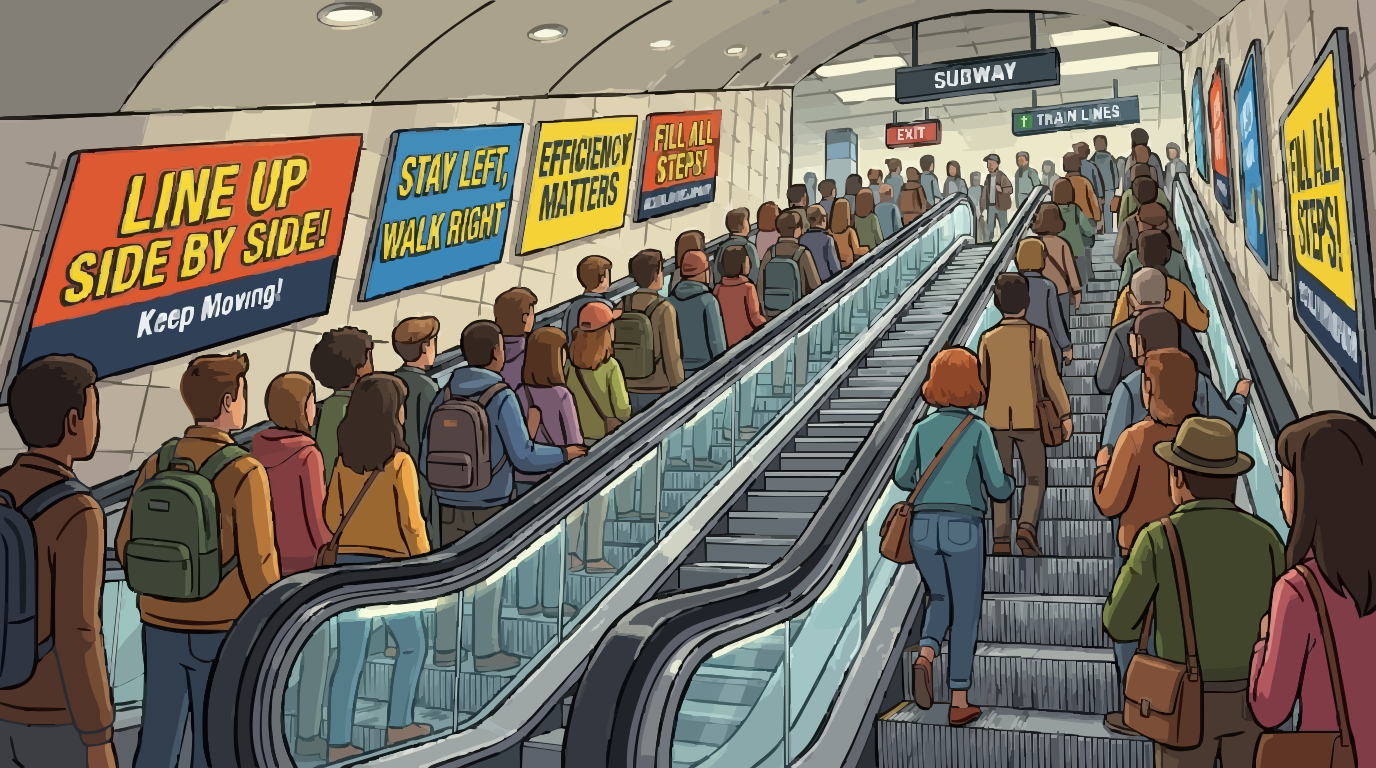
“Stand Still on Both Sides?”: When a slogan meets an old habit on Hong Kong’s MTR
At Central Station at 8:15 a.m. on a recent Monday, commuters stand in a line on the right side of the escalator while the left serves as a moving lane for those in a hurry. Anyone who pauses on that side is quickly met with a brisk “Excuse me.”
“When everyone stands on the right, if you stay on the left without moving, you feel out of place,” said Chan Chi-wai, 37, a clerical worker who commutes from Kowloon to Central every day.
For many, this practice has become one of the city’s unwritten rules, even as a new campaign urges commuters to remain stationary on escalators.
In November 2024, the MTR rolled out a concentrated push for its “Stand Still on Both Sides” (左右企穩/左右兩邊企定定) campaign, building on a safety message it has promoted since 2009, “Hold the Handrail, Stand Still” (握扶手企定定). Yet most commuters keep to old habits.
According to the MTR’s 2024 Safety Brief and other transport studies, walking on escalators offers little time advantage, raises accident risks, and can create uneven loading and wear on machinery. Habits often outlast slogans. The debate also shows the pull between public space, crowd psychology, and Hong Kong’s deeply rooted social norms.
Chan Wing-yi, 26, an accountant, says she wants to follow the campaign, yet practice is hard. “I tried standing on the left once, but people quickly told me to move. The pressure was overwhelming,” she said.
Professor Zhao Tianjiao, who studies urban space, social behavior, and design at Tianjin University’s School of Architecture, says the policy contains some ambiguity. The slogan asks commuters to stand still on both sides, while the long-standing convention treats the left as a moving lane. Acceptance also depends on clear evidence that changing behavior addresses core risks, including efficiency, safety, and the needs of an aging population. “People want to know why something that seemed acceptable for four decades is now called a problem,” Professor Zhao said.
Wong Kwok-hin, 72, a retired civil servant, is skeptical about whether Hong Kongers will amend their views after so long. “No matter what the MTR says, after decades of habit, how do people change?”
There is no indication that the MTR ever formally told commuters to “walk left, stand right.” The convention emerged over time through commuter behavior and informal messaging. In 1985, for example, the Hong Kong Scout Association and RTHK ran a courtesy campaign at several stations encouraging “walk left, stand right,” which helped spread the habit.
“The doubt is understandable,” Professor Zhao said.
Over forty years, the practice shifted from a prompt to a moral norm. If people are asked to reverse it, resistance is likely.
In response, the MTR runs a Safety Experience Zone for families and school groups, partnering with Chibi Maruko-chan in a 2023 public event that involved older residents, and in 2024 rolled out new visuals and station announcements created by Jan Lamb, a well-known Hong Kong actor and singer.
Even so, a frontline staffer who asked not to be named said outreach relies on education and reminders, with limited reach, and many commuters do not notice the messages. “At our station, we mainly offer reminders rather than active enforcement. We do not proactively ask commuters to stand on both sides,” the staffer said.
Building on that, Professor Zhao noted that reminders alone are not enough. “If we create an open forum for discussion, commuters can understand why the new rule exists, and agencies can refine both messaging and on-site practice,” she said. “When the reasons are clear and the messaging is consistent, change is more likely to move from slogan to everyday life.”